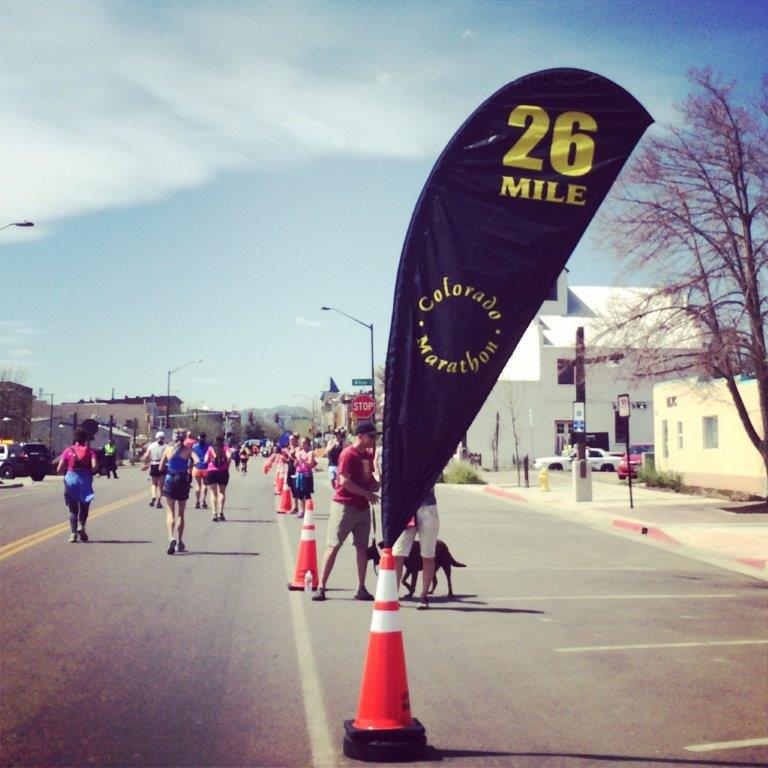
It has taken me several marathons to truly appreciate the value of feeling good at mile 20. Consider all the factors that are at play in a race. There are the internal considerations – your training, your fueling/hydration, your mindset – and the external considerations – temperature, wind, terrain, and your competition. Having the ideal combination of these factors working for you at mile 20 is a gift that provides you the best chance to run your best race. With a foundation of solid training and preparation, good strategic choices along the way, and having the strength, determination, and momentum to finish strong will often make the difference between good and great.
Sharpen your mental game in 3 easy steps
A good race training program will prepare you physically to get to the start line of your next race. By race day, the hard work is in the bank, and you are ready to go. Once you step up to the start line, the real challenge is executing the mental part of the event – a critical piece that most programs fail to cover. Whether it be in a race or at the office, wrapping your mind around goals and tasks is as important as the work you put into complete them.
In running, we spend the majority of our time focusing on preparing our body for a race – and for good reason. I argue that standing at the start line with a 26.2 mile long road in front of you is as mentally challenging as it is physically, and the real challenge on race day has less to do with your body, but more with your mind.
Whether it is the start line of a race, or the beginning of a new fiscal year at work, we are often challenged with wrapping our minds around the sheer size of the tasks ahead of us. At times, trying to figure out how I could hit a sales goal was simply overwhelming. In hindsight, I was burning a lot of emotional energy before I even got the year started. That’s where I’ve been able to apply some of the basic lessons of running – specifically endurance running – to everyday life. How can we better manage seemingly gargantuan tasks? Here are three tried-and-true methods of mental preparation I’ve learned over the years:
- Break down your goal into smaller, familiar parts. Whether time or distance, a big number is overwhelming. You can wear yourself out just thinking about it. I’m a big football fan, and I like to break things up into quarters. What do I need to accomplish in the 1st,, 2nd, an 3rd quarters to be in position to win the 4th? Breaking a large goal into manageable, measurable tasks delivers incremental wins, confidence, and mental clarity.
- Visualize your progress, and remove mental traps. Reaching the half-way point of an 18-mile run on a treadmill isn’t that much fun when you realize you have 9 more miles to go. I often use the mental image of climbing a mountain – up and down. Replacing thoughts of fatigue and pain that I could be associating with later miles are replaced with images of descending down a mountain, and that helps power me through. In my last marathon, I visualized myself as a jet flying over the ocean – fully fueled, fast, and gliding toward the destination. When my body was begging me to stop, my mind was focused on an entirely different image.
- Synchronize body and mind. Don’t worry – I’m not talking about some crazy metaphysical experience here. Rather, I’ve learned to simply focus on breathing. Breathing is a release valve and trigger for our nervous system. Think in terms of our natural fight or flight reactions, and how we often have to take a deep breath to get things under control. A few moments of breathing will help offset our normal physiological reactions. Using our mind to help control our body will allow us use our valuable energy to focus on the task at hand. Whether it is a few moments of clarity before a race, or a big sales presentation, a focused mind and body is a winning combination.
Find more articles and updates at http://runningatthespeedofbusiness.blogspot.com/ and http://businessaccelerated.blogspot.com/
A new mantra… become "harder to kill"
That’s the message delivered in an April 2015 podcast by Ben Greenfield*, a renowned fitness trainer, coach, and author. I listen to all of Ben’s podcasts, and he’s constantly testing new life hacks to gain an edge. Ben spent time with a group of arguably the toughest people in the world – Navy Seals – to learn about how they train and achieve success.
Iron sharpens iron
Well-rounded preparation changes everything
![]() |
| A Tough Mudder race is a humbling and valuable experience. |
You will be hard-pressed to find anyone who can compete with a Navy Seal. That being said, I believe we can learn a thing or two from how they prepare. We face regular moments of truth that separate us from our competition. Our jobs and responsibilities are far different from the Navy Seal, but I argue we often take for granted the complexity of the battles we face every day.
Take a presentation at work as an example. We often think that content is the key, but in truth there are many obstacles that may impact the success of your presentation. Are you a skilled presenter? Do you project a sound image? Are you agile enough to adapt on the fly? What if your time slot was cut in half? How will you address objections that could derail your presentation? A person armed with great content, but not prepared for the other obstacles, would ultimately not see the success they had hoped for. Like the Navy Seal heading into combat, you need to be ready for anything, and you have to rely on your preparation to achieve success.
Success is a process, not an event
A change of pace to boost productivity
As a runner, we know that in order to optimize our performance we need to employ a number of different workouts. Running at the same speed is a recipe for burnout and diminishing returns. We mix up our workouts to help keep us sharp – physically and mentally. There is a place for those long, slow runs, but there are reasons why we amp it up with a tempo run, or when we really want to take it up a notch, some intervals on the track.
- The Interval Session. On the track, we’re running at a fast target pace for a defined distance and/or time. Think in terms of running an 800 meter sprint. There are few distractions, our mission is clear, and our focus is sharp. All of our energy is focused on what it takes to get to the finish line. Transfer this mentality to the office, and you will love the results. I read about a time blocking idea called the “Pomodoro Technique”, which involves setting a timer for 20 minutes and focusing only on that one task. I literally set a kitchen timer on my desk and allow myself to only focus on one thing. For me, my interval workout at the office is cleaning up email at the beginning of each day. Most often, I’ve got my email box organized and down to one screen, all before the timer rings. Sometimes that used to take me all day!
- The Tempo Session. This is a longer run than an interval run, but as the name suggests, at a spirited tempo. It’s focused, timed, and done with a purpose – to help lock in a faster pace, or for work purposes, knock out a list of to-do items. I’ve employed this technique with external-focused tasks, such as setting appointments and client follow-ups. I schedule an hour for myself to fire up my CRM and calendar and shut down my other windows to get my schedule set.
I’ve kept these sessions focused and distraction-free, and I’ve been pleasantly surprised at the outcomes. Running at the same pace all of the time won’t make you a better runner, and working at the same pace without structure and boundaries won’t make you more efficient and effective at the office. With a little creativity and discipline, your goal of being a better time manager just got a whole lot easier!
Running for good
Martin Luther King Day is a celebration of the life and work of generations of people, recognizing how far we’ve come, but also how far we have yet to go. It’s more than a day off work – it’s a day to remember, pay tribute to a great American, and get out and do something positive for the community.
On my Monday run this week I ran past a few kids picking up trash in the neighborhood. Normally, they would be at school, and I wondered if the community service was part of a MLK-inspired spirit. As I often do, I started thinking about the opportunities we have every day to make a difference in our community, and I started thinking about all of the things the running community does to strengthen the neighborhoods we live in.
I’ve participated in dozens of races, from the tiny school fundraisers to giant marathons. In between, I’ve raised money for playgrounds, preventing human trafficking, First Responders, cancer research, AIDS projects, animal welfare, housing for Veterans, and pool safety awareness, just to name a few. Almost every race out there donates some of their proceeds to charity, and that adds up!
As distance running became more popular and race bibs became tougher to get, race directors decided to reserve a few coveted spots for charity runners. In exchange for a fundraising, an aspiring marathoner could gain entry to Boston, Chicago, New York. A 5-hour marathoner won’t qualify for any of these, and without a little bit of luck in the lottery, they may not otherwise have a chance at running in these events. Today there are thousands of runners that gain entry every year to races, each raising thousands of dollars each. Depending on the race, a charity runner may need to raise anywhere from $500 to $4,000.
Think about how much money runners generate for our communities. Sure, our races shut down a few streets for a few hours every now and then. That may be an inconvenience for a few bystanders and nearby residents, but they probably have no idea what good is being done for the communities they live in. According to the New York Marathon, the 2014 race included 8,500 charity runners who raised $34.5 million – all of that money goes directly to dozens of accredited charities. The marathon also donated approximately 26 tons of discarded clothing from the race, and they sent that to Goodwill.
As a runner, I am proud that my hobby and passion can generate some good for the communities I live and work in. There’s more to the story, however. The dedicated race organizers and volunteers – not to mention the Police, Fire, and EMT’s that work the events – that make these events a reality never seem to get the credit they deserve. On this special week when we honor a great American, I’m grateful for those in my community who work hard to improve our neighborhoods each and every day.
Find more articles and updates at http://runningatthespeedofbusiness.blogspot.com/ and http://businessaccelerated.blogspot.com/

Breaking through plateaus with cross training
In my years of running I have learned one of the most important realities of personal growth – where there is progress, there is likely a plateau ahead. Whether it be physical, mental, or some of both, our body does a great job of adapting to what we ask it to do, and we’re not seeing the net gains we became accustomed to. What can we do to avoid the dreaded plateau?
As runners, we want to “raise the bar”, and early returns (often leaps and bounds) in our training provides a sense of confidence and raise expectations. Shaving minutes off a race time is not uncommon at first, but we soon learn, our training efforts do not necessarily produce linear results over the long term. Our results feel like a series of peaks and valleys, rather than a steady climb. Those minutes we shave off our times reduce to seconds, and further incremental gains are even tougher to achieve. The training “plateaus” we experience are common, and in many cases, we see performance declines during the plateau stage. That can be frustrating, and often leaves us wondering what we are doing wrong.
I’ve had the opportunity to work with a number of coaches over my years of training, and there is a reason why investing in coaching works. Simply put, doing more of the same won’t always help take my training to the next level. I’ve had two significant breakthroughs in my running career – the first was breaking a 3-year decline in marathon performance, and the second was bucking the trend once again and breaking through the 4-hour marathon mark. After a ho-hum 2015 marathon, I realized that I was on another plateau, and I wanted to change things up a bit.
My current coaches, Simon Escorcia and Tristan Mitchell at Denver-based RunColo Training have helped me integrate a number of time-tested workouts over the past two years, and now we’ve added some non-running exercises into my normal routine to help me find the “next gear” of personal performance. I’ve seen gains already. From a physical standpoint I feel great, and perhaps more importantly, it’s helped my mental outlook. It’s 15 degrees and snowing as I write this, and I’m headed out this afternoon for yet another winter “dreadmill” workout. The WOD’s I’m doing during the week break up the monotony of the treadmill, and provide a dose of the feeling of progress that we all strive for. I’m hopeful that my winter cross-training will change the trajectory of my training in the spring when I add more mileage.
Our bodies are amazing machines that are great at adapting to new challenges. What worked last year may not be the recipe for success this year. Don’t be afraid to mix a few new things to your weekly schedule to strengthen your body, physically and mentally. Hopefully that extra work today will give you that “next gear” at mile 20 this fall!
Find more articles and updates at http://runningatthespeedofbusiness.blogspot.com/ and http://businessaccelerated.blogspot.com/
Resolutions – improve your chances of achieving success!
Running was once a New Year resolution for me, and it’s one that I’ve actually followed through on (we won’t discuss the countless ones that I did not!). Way back then, my goal was to run the Bolder Boulder, a 10k race. I finished, but the goal itself was not the reason why it worked. It was the structure – my online training program – that helped make the goal a reality. Credit the Hal Higdon beginner 10k running program for that helping me achieve that goal! The races and distances have changed over the years, but making sure that I had the structure in place has always been there.
We have big goals, and we set them for a reason. It is important to invest time and energy into how we can make those goals achievable. I have resolved to follow three simple rules:
Allow your goals and checkpoints to be the “training program” to help you achieve your goals, and refer back to it early and often.
Here’s to a healthy and prosperous New Year!
Thanksgiving – a time for memories
This Thanksgiving holiday, many of us are planning to lace it up one more time at whatever Turkey Trot is in our area. I’ve always enjoyed these “end of year” races – the heavy lifting is over, we’re burning calories in advance of the biggest meal of the year, and this is a victory lap of sorts. It’s also about friends, family, and tradition.
Of all the races I’ve done, the most memorable are the races I’ve done with my 11-year old daughter Ripley. She’s not much into training, but she can crank out a 5k fun run on a whim. She’s learning the ropes, and it’s been a joy to teach her a few things. She has selective memory, though, as she occasionally likes to go out too fast, power up hills, and drink too much water before the race starts (then it becomes a race to the closest bathroom…). She’s competitive, and gets frustrated when she gets a cramp, blister, or side stitch. We’ll make a goal to pick off other runners, gradually improving our placement in the field. We have a tradition in our house to pin our race bib on the wall in the garage, and she will proudly point out hers and tell you stories about each race. I remember and cherish those experiences as well – running may not end up being one of her passions, but it’s been something we’ve been able to share.
We remember moments, and there is one in particular that I’ll always remember. We were running together at a 5k fun run fundraiser race a couple of years ago. It was a hilly course and a hot day, and lets just say it wasn’t “fun” 100% of the time. It gave us an opportunity to chat about practice, patience and perseverance. Fortunately the half mile was downhill, so our spirits dramatically improved. With about 150 yards left in the race Ripley saw the finish line and took off. It was the first time we ran apart all day. I ran after her and proudly watched her raise her arms above her head as she crossed the finish line and proclaimed herself “the winner”!
She did cross the line first, and for that she claimed bragging rights. For me, have never been prouder or happier to finish in second place.
I wish you and your families a very happy Thanksgiving. Travel safe, and enjoy the moments and memories you share together.
James
Coaching – unlocking your true potential!
“All coaching is, is taking a player where he can’t take himself.” – Bill McCartney
We have a lot to worry about in life, and that element of worry burns a disproportionate amount of positive energy, and often creates negative energy. Mike, my professional coach, reminded me of that this week, and it helped reset my mindset and priorities. More often than not worry stems from things we cannot directly control, and staying focused on what we can control will yield greater (and more positive) results. We have a finite amount of energy, and we should invest it wisely!Can you achieve great things on your own? Absolutely. But I would argue that coaching – at the right time and place – can provide you with an honest assessment of where you are, and plan a path for the future. Whether it’s a momentary mental reset, or sitting down to focus on goals and strategy, effective coaching can catapult you to the next level, helping you achieve things that may have previously seemed out of reach!
Remembrance
Today is Veterans Day (Remembrance Day in Canada, my home country). Around the world we honor our Veterans and the men and women who currently serve.
As a runner I am proud that the running community takes time to celebrate our heroes, and we do so regularly. I remember my first ever race – the 1999 Bolder Boulder – seeing the team of runners in military fatigues running the 10k course in formation. If that wasn’t tough enough, they did a series of pushups in front of the finish line, then they crossed. The crowd went crazy!
On Memorial Day weekend this year I entered a Memorial Day Run and March in my hometown of Castle Rock, Colorado. There were 5k, 10k, and 30k events – I ran the 5k, but finished up to catch some of the 30k race. The 30k race (actually it was a march) was primarily run by military members, and was administered by a Norwegian Army Officer. Here’s the kicker – the military members were in their full fatigues, and they also had to wear a rucksack filled with 25 pounds of food throughout the race that would be eventually donated to homeless veterans. The Norwegian Officer presented each qualifying military marchers with the Norwegian Foot March Medal worn by the Norwegian Army. It was a truly eye-opening and inspiring event!
We are touched by the sacrifices of all of the men and women in our Military here at home and around the world. As runners we occasionally have moments like these to help celebrate their service, and we will celebrate their service today. On this special day, we celebrate and remember all of our military heroes and their families. Thank you for your service!